
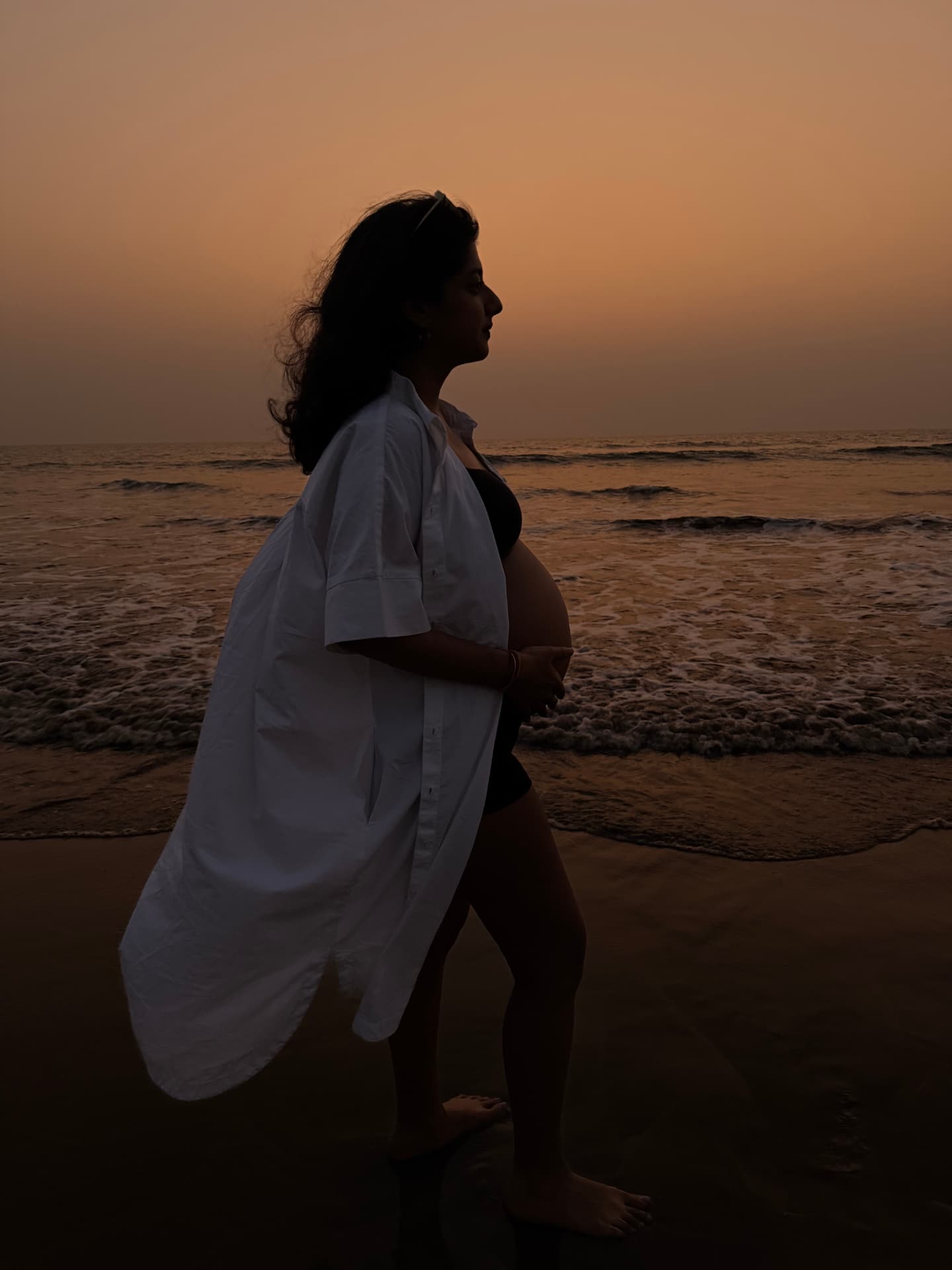
Cesarean birth · Mumbai
The Daughter I Nearly Lost and Found Again
Sneha
I’ve always had very strong maternal instincts, but I didn’t know how much I wanted to act upon them. As a woman, and as easily as the belief is thrown around, you cannot have it all. That is the order of society, of biology. Of course, science is working overtime to make things just that much more possible for women, but the reality at ground level is as complicated as it can get. And someone, many a one, is always holding fort, managing the cacophony in the backdrop, for women to want to have it all.
As a woman who has always held her own, it took me a long time to want to experience motherhood for myself. I never anticipated the journey I was embarking upon.
Our first scan after a positive pregnancy test was primarily to rule out an ectopic pregnancy. It showed us a single sac. Somewhere around the third or fourth scan, to our absolute surprise , the radiologist spotted two separate sacs with two distinct heartbeats, confirming that it was a Monochorionic diamniotic pregnancy, or, in layman’s terms, an identical twin pregnancy where the foetuses share a placenta but are housed in two separate sacs.
She told us it was the slightly riskier of the twin pregnancies, an ambiguous detail that got us to worry a little.
On meeting my OB-GYN, Dr. Riddhima Shetty, which, by the way, was one of the best decisions I made along this journey, we were relieved to know that there wasn’t much to worry about, and even less to do. We just had to hope and pray that things went according to plan, tread with caution, and zip it up until the end of the first trimester.
She was the perfect balance between caution and ease. Her clinic became my safe space.
We were elated , and yet couldn’t do much or talk much about it. Everything was to be hush hush and protected. Honestly ever since - reality has never really sunken in.
I must add here: it’s so important to have a doctor who, besides being incredible, is also easily accessible, both in person and via chat. We underestimate the importance of logistics, traffic, wait times and response times during pregnancy. One of our scans at a hospital had us waiting for nearly three hours. This was in my seventh month. Insanely heavy that I was, I had to request them to let me lie down in one of the rooms.
The best thing about Dr. Riddhima, besides her calm, positive demeanour and her ability to be both measured and decisive when it mattered, was that her clinic was very close to where I lived. I hardly ever had to wait if I called in advance and went in. The few things you can control in an otherwise unpredictable pregnancy, the few things that can keep you sane in an otherwise crazy time and space.
It’s tough, this pregnancy thing.
For one, I had nausea for practically most of my eight months, barring a few weeks here and there around the second trimester. So much so that the sight of my kitchen made me want to throw up. I practically threw up every week of my pregnancy, and some weeks, almost every alternate day, if not every day.
Breathlessness was inevitable, and for someone who uses her voice for a living, I nearly lost mine through the phase. My tone became deeper, heavier and more strained. I couldn’t string more than a few sentences together at a time. I somehow managed to take up work. Perhaps so many years of working had built in some muscle memory that helped me sail through one of the most difficult phases of my life.
But it was really tough.
For someone who thrives in her own company, I suddenly needed someone just to step out of the house with me. I was almost always accompanied by Mum or Varun. I would avoid meeting people or speaking on the phone because a few lines would leave me feeling tired.
I kept myself calm for the sake of the two little babies growing inside me. I painted a lot, solved crosswords, read one too many books and binge watched OTT, mostly old SRK movies, after I had exhausted everything else on the list.
One of the wiser decisions we made during this time, on getting a go ahead from our doctor, was to take three days off to Goa during my second trimester. We kept it simple. Very little moving around, a beach property, and absolutely no agenda. Although it seemed like such a tough decision to make back then, looking back, I’m so glad we did it. I have no idea when we’ll next be able to take off quite so easily. Travelling with two babies, after all, is like travelling with an entire village.
Because it was a fairly high risk pregnancy, I was told very early on that we would aim for a C section delivery. I trusted my doctor more than anything and left that decision to her discretion.
Despite the hurdles, a lost voice, extreme nausea and breathlessness, I had a surprisingly smooth pregnancy. I found ways to keep myself occupied and, more importantly, at peace.
I would eagerly wait for my husband to get home so we could head out for ice cream, a snack or a dessert. Anything to spruce up a gloomy day.
We even managed to make it to the theatres for reruns of two of my favourite SRK movies, Dil Se and Main Hoon Na. A Samay Raina show, a Sunidhi Chauhan concert and meals at some of my favourite restaurants soon followed.
Looking back, I’m so glad we made the effort to find these little pockets of joy in an otherwise difficult time.
Personally, I wanted to cross the 36 week mark, and my doctor felt it looked achievable based on the scans. But closer to the 34th week, I felt slightly less movement on a particular day and went in for an SOS scan.
The scan was mostly okay, but my younger baby had moved into a breech position and had a loose double loop of the cord around her neck. The doctor wasn’t panicking, which was reassuring, but suggested that we not delay the delivery by more than a week and look to schedule the surgery sooner rather than later.
While I really wanted them to stay in for a little longer, I trusted the medical advice. We went in for a C section at 35 weeks and 5 days, after I was administered the lung steroid injections.
We chose Surya Hospital for our delivery. I insisted on having my husband inside with me, something a friend wasn’t allowed to do, and I still wonder why. I was met with no resistance whatsoever.
I had the most peaceful delivery. A lovely anaesthesiologist whispering kind things to me. The best partner holding my hand through it all.
I heard the cries and was told they were girls.
Oh, the joy and relief. Also because, in the case of identical twins, both babies will be the same gender.
"Can be found above."
That was all I needed to hear before I passed out.
I couldn’t quite follow what was happening around me, but both babies were quickly taken aside onto separate tables. Their breathing was being monitored because they were showing signs of respiratory distress. I barely saw their faces before, in my semi conscious state, I was told they had to be rushed to the NICU.
My poor husband didn’t know whether to stay back with me or rush out with the babies.
When I regained consciousness, I was in a room with another mum to be who was waiting for her surgery, while I was under post surgery care.
Our babies were in the NICU for four days, initially for respiratory distress and eventually for signs of jaundice.
The toughest four days of our lives.
You’ve just given birth, or so you’re told. There’s no tangible proof of child, or children in this case. No smell. No sight. No touch. The only thing left with you is this extreme pain, unfathomable pain that neither the mind nor the body has the power to grasp.
My doctor would come and check on me twice a day. While examining me on the first night post surgery, she said I was ready to express milk and feed my babies at the breast. For that, my catheter had to come off, which meant I needed to be able to walk to the bathroom on my own, sit up on my own, and get the job done.
The excruciating pain that followed was powered through by one thing alone: my desire to go and hold my babies.
The first step took me to hell and back. But a woman’s endurance is something else.
I cringe when I look back at it now, but back then, I wasn’t even thinking about the pain.
I took my first walk, after which I was told I was ready to go to the NICU.
The walk to the NICU, despite having wheelchair assistance, was the walk of death.
I went to their incubators and saw them both bundled in wires and masks, breathing with assistance. It broke my heart into a million pieces.
This was not how I had anticipated seeing my babies clearly for the first time.
I cried a little.
I held them, one by one, with the assistance of the nurses there. I fed one of them at my breast. It felt like I was invoking life.
The way my little one took to it was like an ant finding its way to a crystal of sugar.
Pure joy.
At least I got to hold them. My husband could only managed a glimpse through the glass that separated him from the babies. Those four days were as hard on him emotionally as they were on me physically.
Something my doctor said stayed with me for a long time after: “Your babies love you more than you know. They stayed in the NICU a little longer so that you could get the rest you needed to get back to them with more strength and vigour.”
My trips to the NICU were reassuring, to say the least. An endearing bunch of nurses and staff, all incredibly skilled and warm, were like god sent parents to my babies.
My husband and I, as restless as we were, got our rest over those four days. More importantly, we got some strength for the journey that lay ahead.
I had some incredible nurses teach me how to use the breast pump, how to express milk, how to feed the babies, and how to swaddle them.
The lactation consultant didn’t show up until the last day, and even then, only because we insisted that I meet her, which I felt wasn’t how it should have been. But for most of it, I only felt grateful.
A twin birthing experience, as uncomplicated as it could possibly be, is still the toughest thing I’ve ever done as a first time mother of two.
And I wonder why motherhood, and every decision that comes along with it, is so hard, and yet so underrated and understated.
Women have simply done it, over and over again, for generations, without as much as a sigh.
I also wonder: if men were the ones who gave birth, would things be different in our world?